The Cotswolds in a Campervan: A Guide to England's Most Scenic Countryside
There are few corners of England more immediately lovely than the Cotswolds. Stretching across parts of Gloucestershire, Oxfordshire, Wiltshire, Warwickshire, and Worcestershire, this 800-square-mile Area of Outstanding Natural Beauty is a landscape of rolling limestone hills, ancient woodland, and villages that look as though they haven't changed since the 17th century — all built from the same warm honey-coloured stone.
It's also one of the best destinations in England for a campervan trip. The roads are unhurried, the countryside rewards slow travel, and there's always another village around the next bend that wasn't on your original plan but turns out to be the highlight of the day. Here are eight destinations to anchor your Cotswolds itinerary, along with some practical tips for getting the most from your time on the road.
1. Bourton-on-the-Water

Often called the Venice of the Cotswolds, Bourton-on-the-Water earns the nickname. The shallow River Windrush runs through the heart of the village, crossed by a series of elegant low bridges, and on a warm day the grassy banks fill with families paddling, picnicking, and making the most of the sunshine. It's one of the most visited villages in the Cotswolds — which means it can get busy in peak summer — but it's busy for very good reason.
Beyond the riverbanks, there's plenty to explore: the Model Village is a remarkably detailed 1:9 scale replica of Bourton itself, carved from Cotswold stone, while Birdland Park is home to more than 130 species of bird including penguins, flamingos, and macaws. Both are particularly good with younger children. The vill
age has a good range of tearooms, pubs, and independent shops lining the main street.
Plan your visit: cotswolds.com/plan/towns-and-villages/bourton-on-the-water
2. Bibury and Arlington Row
William Morris described Bibury as the most beautiful village in England. Whether or not you agree, it's hard to argue with Arlington Row — a terrace of 17th-century weavers' cottages owned by the National Trust that has become one of the most photographed streetscapes in the country. The honey-stone buildings, the meadow of Rack Isle opposite, and the clear waters of the River Coln running alongside make for a scene that feels almost impossibly perfect.
Bibury is small and genuinely tranquil if you visit early in the day before the coaches arrive. The village also has a working trout farm on the river — the Bibury Trout Farm is one of the oldest in England, and you can feed the fish or even buy fresh trout to cook back at the van.
Plan your visit: nationaltrust.org.uk/visit/gloucestershire-cotswolds/bibury
3. Chipping Campden
If you had to pick one Cotswolds town that best captures the character of the whole region, Chipping Campden would be a strong contender. Its long curving High Street is lined with some of the finest examples of Cotswold architecture anywhere — wool merchants' houses, the stunning 15th-century Market Hall standing in the middle of the road, and the soaring tower of St James' Church visible from miles around.
Campden was at the heart of the Arts and Crafts movement in the early 20th century, when C.R. Ashbee brought his Guild of Handicraft here from London, and that creative legacy still runs through the town today. It's also the northern terminus of the Cotswold Way, a 102-mile walking trail that runs all the way south to Bath — even a short stretch of it from the town makes for a beautiful afternoon walk through the surrounding farmland.
Plan your visit: https://www.cotswolds.com/plan/towns-and-villages/chipping-campden/
4. Stow-on-the-Wold
Perched at 800 feet above sea level, Stow-on-the-Wold is the highest town in the Cotswolds and one of its most characterful. The large market square at its centre is lined with independent antique shops, galleries, and pubs, and on market days it still feels like the working agricultural hub it was for centuries. The eight narrow lanes that feed into the square — called 'tures' locally — were originally designed to funnel sheep into the market, which gives you a sense of the town's long history.
The Church of St Edward is worth a visit for its famous north door, a pair of ancient yew trees framing the entrance that are said to have inspired J.R.R. Tolkien's depiction of the gates of Moria. Whether or not that's true, it's a striking sight. Stow is also well-placed for exploring the surrounding Slaughter villages — Lower and Upper Slaughter are just a couple of miles south and are among the quietest and most unspoilt settlements in the whole of the Cotswolds.
Plan your visit: cotswolds.com/plan/towns-and-villages/stow-on-the-wold
5. Burford — The Gateway to the Cotswolds
Burford sits at the eastern edge of the Cotswolds and is often the first town visitors encounter coming in from Oxford or London. Its single main street drops steeply down towards the River Windrush, lined with independent shops, antique dealers, bakeries, and pubs that have been trading here for centuries. It's one of those places where an hour's wander quickly becomes a whole afternoon.
The Church of St John the Baptist at the foot of the hill is a fascinating building that traces almost every period of English church architecture from Norman to Perpendicular Gothic. Inside, there's a poignant memorial to the Leveller soldiers imprisoned and executed here in 1649 — a reminder that this quiet market town has its own complex history. Burford is also a useful base for exploring the surrounding countryside; the Windrush Valley to the west is particularly lovely.
Plan your visit: burford.co.uk
6. Winchcombe and Sudeley Castle
Winchcombe is one of those Cotswolds towns that feels genuinely lived-in rather than preserved purely for tourism — there are butchers, bakers, and local pubs alongside the visitor attractions, and the surrounding walking country is some of the best in the region. The Cotswold Way passes right through the town, and the paths up onto Cleeve Hill give views across the Vale of Evesham that are hard to beat on a clear day.
Just outside town sits Sudeley Castle, one of the most romantic historic houses in England. The castle has a royal pedigree — Katherine Parr, the last of Henry VIII's six wives, is buried in the chapel here, making it the only private castle in England to contain the tomb of a queen. The gardens are exceptional, particularly in spring, and the castle itself is open daily from March through to November.
Plan your visit: Winchcombe:https://www.winchcombe.co.uk/ | Sudeley Castle: sudeleycastle.co.uk
7. Broadway and Broadway Tower
Broadway is frequently described as the show village of the Cotswolds, and it's easy to see why. The broad main street (the name is literal) is lined with honey-stone buildings, and the village has attracted artists, writers, and well-heeled visitors since the Victorian era. It's polished and popular, but still genuinely beautiful — a long afternoon walk along the High Street, lunch at a village pub, and a browse around the galleries makes for a very pleasant day.
Two miles south of the village, Broadway Tower stands at over 1,000 feet and offers one of the most remarkable viewpoints in England. On a clear day, the views extend across 13 counties. The folly was built in 1798 for the Countess of Coventry, who wanted to know if a beacon lit on the hilltop could be seen from her home in Worcester (it could). There's a small visitor centre, a cafe, and a pleasant walk up through the country park from the car park below.
Plan your visit: Broadway: visitbroadway.co.uk | Broadway Tower: broadwaytower.co.uk
8. Blenheim Palace, Woodstock
Blenheim is the grandest thing in the Cotswolds — a UNESCO World Heritage Site, the birthplace of Winston Churchill, and the ancestral seat of the Dukes of Marlborough. The palace itself is extraordinary, but it's the 2,000-acre Capability Brown landscape that makes a visit truly memorable. The formal gardens, lake, cascade, and woodland walks are all included in the admission price, and a full day here barely scratches the surface.
The pretty market town of Woodstock sits at the palace gates and is well worth an hour of your time in its own right — good pubs, independent shops, and a relaxed pace that contrasts nicely with the scale of the palace next door. Blenheim is open year-round, though the palace interior has seasonal opening times; check the website before you visit. The parkland is a particularly wonderful place to be in autumn when the trees are turning.
Plan your visit: blenheimpalace.com

Practical Tips for a Cotswolds Campervan Trip
When to go: Late spring (May and June) and early autumn (September and October) are ideal. The light is beautiful, the crowds are thinner than high summer, and the countryside is at its best. School holiday weekends in July and August bring heavy traffic to the most popular villages — Bourton-on-the-Water in particular can feel overwhelmed on a sunny Saturday afternoon.
The roads: The Cotswolds is perfect campervan territory — you don't need height or width clearance beyond what a standard VW T6 or California provides, but do expect single-track lanes with passing places on routes between smaller villages. Take it steady, use a mapping app rather than solely relying on a sat nav, and don't be afraid to reverse — it's part of the experience.
Campsites: There's a good spread of campsites across the region, from basic farm fields to well-equipped parks. Book ahead for any visit between late June and August, as the best sites fill up quickly. For a full listings search, visit cotswolds.com or hipcamp.com.
Wild camping: Wild camping is not legally permitted in England. Please use designated campsites — there are plenty of excellent options throughout the AONB and the surrounding area.
Walking: The Cotswold Way runs 102 miles from Chipping Campden to Bath and can be dipped into at almost any point along its length. Even a two or three mile section from a village gives you a completely different perspective on the landscape. Download the Ordnance Survey app for detailed route information and offline maps.
Getting there from Hampshire: The Cotswolds is around two hours from Romsey depending on your starting point within the region. The M3/A34 via Oxford is the most direct route to the southern and eastern Cotswolds; the M5 via Bristol brings you into the Gloucestershire villages from the west. Either way, arriving on a weekday morning rather than a Friday evening will save you considerable time and stress.
Ready to Explore the Cotswolds?
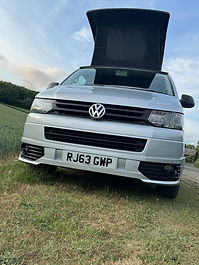
Our VW campervans are perfect for exactly this kind of trip — compact enough for the lanes, comfortable enough for a week on the road. If you'd like to talk through a Cotswolds itinerary or check availability, we'd love to hear from you.
Browse our vans at campercharter.co or drop us a message on WhatsApp at 07908 293703 - we're happy to help you make your trip memorable.




Comments